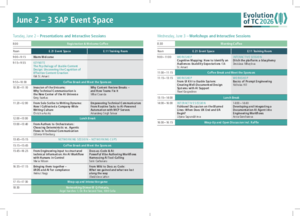
Check out the conference program
Christina Ausley
From Solo Scribe to Writing Dynamo: How I Cultivated a Company-Wide Writing Culture
Five years ago, I joined Camunda as the company’s only technical writer. The challenge wasn’t just writing documentation—it was improving how writing happened across the entire organization. Instead of treating writing as a specialized skill owned by one team, I set out to make it a shared capability. This talk explores how a Writing Center of Excellence helped engineers, product managers, and contributors across the company produce clearer, more consistent, and more user-focused content. Through practical resources like a style guide and glossary, hands-on workshops, and self-service tools, colleagues gained the confidence and structure to write better. I’ll share what worked, what didn’t, and how building visible support for writing transformed documentation from a bottleneck into a collaborative practice.
Sorin Carbunaru
Docs-as-Code & AI: Powerful Vibe Authoring Workflows Harnessing AI Tool-Calling
Software developers like myself increasingly rely on AI-powered tools embedded directly in their working environment to augment their capabilities and accelerate productivity. Why should technical content creation be any different? In this session, we'll explore how the Docs-as-Code philosophy — treating documentation as code — can evolve by adopting the same AI-assisted approach. Just as developers use AI with tool-calling capabilities to explore the project or run terminal commands, documentation teams can integrate AI tool-calling directly into their authoring workflows, granting writers the same powers. Together we'll examine how this integration can improve the experience of technical writing. Real-world examples will show how teams can accelerate content production, preserve quality and voice, and reduce context switching.
Uladzislava Lahun
From Wiki to Docs as Code: What we gained and what we lost along the way
When our company decided to migrate from Confluence to a new documentation platform, our technical writing team faced a choice: follow others to a new platform or rethink how documentation is stored and move it to live alongside the product itself. We chose the second option and transitioned our documentation to a docs-as-code approach, maintaining it in a repository close to the source code.
We aimed to bring documentation closer to development workflows so that changes could be reviewed alongside code. With the docs-as-code approach, automation became easier to introduce, and long-term scalability and versioning felt more robust. As an accidental bonus, this approach also laid the foundation for future automation and AI-assisted workflows.
However, the transition came with high costs and hidden issues. Both non-technical and technical contributors faced difficulties, and the learning curve turned out to be steeper than expected. The process itself became more complex, required additional tools and guidelines, and overloaded the team, which eventually became a bottleneck.
Elzbieta Wiltenburg
From Authors to Orchestrators: Choosing Deterministic vs. Agentic Flows in Technical Communication
Agentic AI is changing how technical information gets created, checked, and released—but not every workflow should be handed to a free‑roaming “AI agent.” In this talk, I’ll show a practical decision model for documentation teams: when to use deterministic orchestration (explicit, auditable workflows) and when to embrace agentic loops (adaptive problem‑solving). I’ll compare the two styles on predictability, governance, review effort, and measurable throughput, and I’ll illustrate both with the same end‑to‑end scenario: 1) draft, 2) validate, 3) publish. You’ll see UX patterns for human‑in‑the‑loop control, guardrails that keep outputs safe, and a set of metrics used in both types of flows. You’ll leave with inspiration and a checklist you can implement next week at your own work. All this to help you plan and execute on how to move from point tools to orchestrated, AI‑assisted authoring at scale.
Desislava Mihaylova
From ‘No’ to Launch: Moving a Help Center Against the Odds
This session is about a tough but rewarding journey - how I led the switch to a new platform for our company’s help center after more than two and a half years of persistence.
Since day two at our scale-up, I’ve been advocating for migrating the help center to a proper CMS. It took countless conversations, persuasion, and navigating unclear processes to align everyone and make it happen - moving away from a system built for support agents to one designed for users. Along the way, I disagreed but committed and kept looking for opportunities to turn every *no* into progress rather than a dead end.
In this interactive session, I’ll share my key takeaways from achieving what once seemed impossible in a fast-moving environment with no precedents. After a 20‑minute presentation, participants will split into small groups to exchange experiences and ideas on driving change when the odds (or the answers) aren’t in your favor.
👉 Join me to learn, discuss, and get inspired - because persistence, mindset, and commitment can transform any “no” into a “let’s do it.”